
A newly unveiled Hermès store in Beijing blends architecture, material depth, and cultural nuance into a space that feels less like retail and more like a quiet statement.


The Hermès Beijing flagship store in Beijing does not try to impress at first glance. Instead, it chooses to hold back.
It builds its presence through material, light, and restraint, creating an environment that feels considered from the moment you step inside.
This is not just a store opening. It is a different way of being seen.
A Store That Feels Part of the City
Opened in April 2026, the space marks Hermès’ fourth address in Beijing since 1997. It sits in the Sanlitun district and stands as a five-storey, free-standing structure.
Rather than relying on glass-heavy visibility, the façade introduces a more layered expression. It uses rose-pink and terracotta ceramic tiles, creating a surface that feels both contemporary and historically grounded.
RDAI designed the project together with Mamou-Mani Architects. Together, they shaped a semi-transparent façade that works like a veil.
As a result, the structure balances openness and opacity. It also allows natural light to enter the interior in a softer way.
The design takes direct inspiration from the nearby Forbidden City. It echoes curved rooflines, warm tones, and layered materials. At the same time, it builds a clear dialogue between local cultural heritage and Hermès’ design language.
Inside, Nothing Rushes You
Step inside, and the space unfolds vertically.
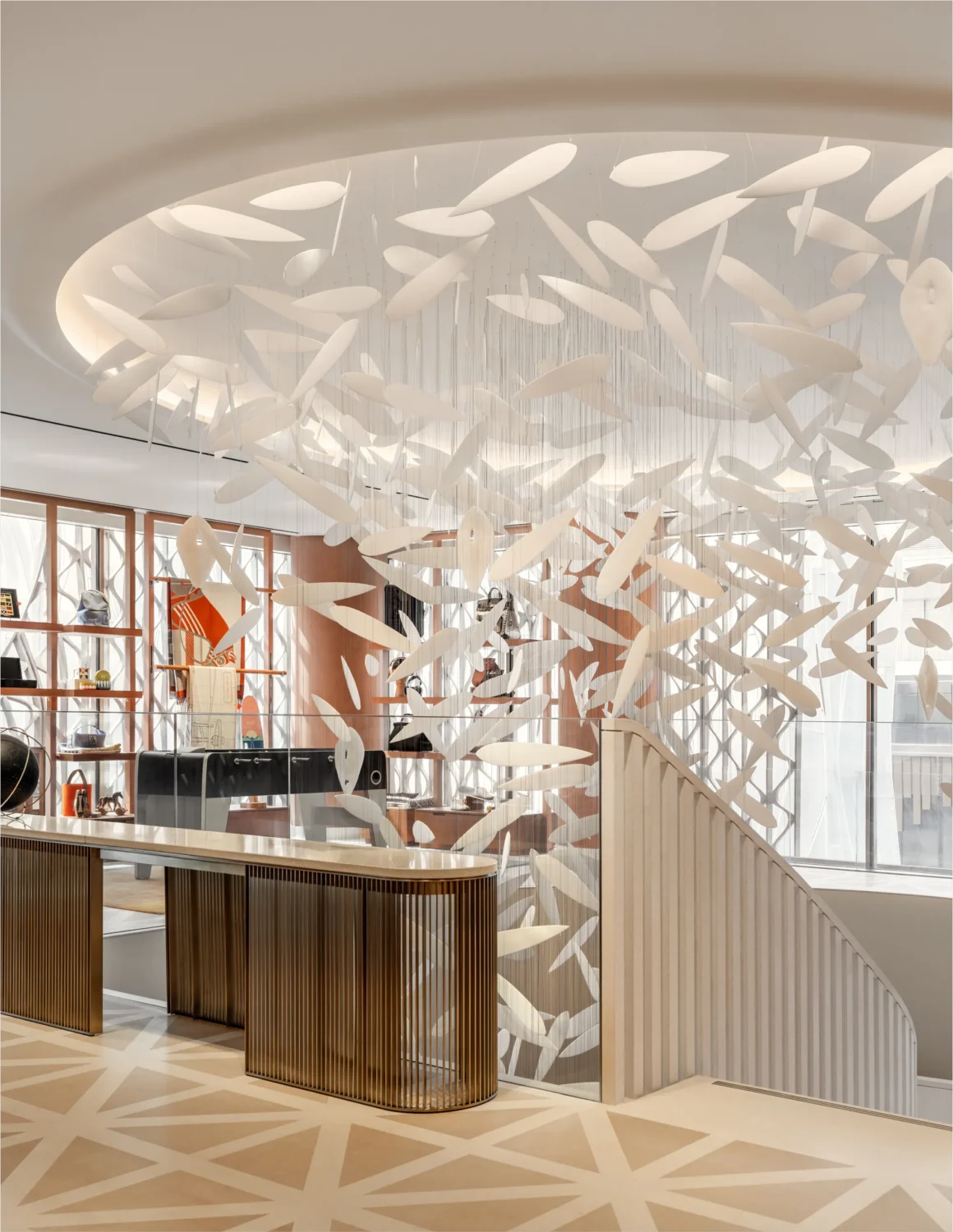
Each level introduces a new atmosphere. Materials shift. Light changes. The rhythm evolves as you move upward.
There is no single moment designed for instant impact. Instead, the store guides you through a sequence of immersive environments.
Light moves softly across surfaces, shaping perception rather than forcing attention.


Across the five floors, the Hermès Beijing flagship store presents its sixteen métiers. Each universe holds its own identity.
Leather, textiles, objects, and ready-to-wear are not grouped for efficiency.
Instead, they are arranged for experience.
Nothing feels over-arranged. Nothing feels loud.
You do not move quickly through the space.
Instead, the space lets you slow down.
Craft Becomes the Message
The store does not rely on what it adds. It defines itself by what it avoids.
It removes visual noise. It avoids exaggeration. It leaves out urgency.
Instead, Hermès focuses on craft, tactility, and narrative depth.
Products do not sit on top of the space. They exist within it. Because of this, the experience feels more natural and more lasting.
The store does not ask for attention.
Instead, it invites observation.
Why the Hermès Beijing flagship store feels different
In a retail landscape driven by visibility, this approach feels almost unexpected.
Because it slows everything down.
And that shift matters.
This flagship shows that luxury does not need to be loud to be understood. It can exist through texture, movement, and time.
It can also live in how a space feels, not just how it looks.
Hermès does not redefine itself here.
Instead, it refines how it appears.
In the end, it leaves behind a simple idea:
Luxury is not what you see first. It is what stays with you after you leave.
➡️ Explore more Lifestyle stories that rethink space, design and cultural experience.

