
BIG’s first completed buildings in Japan are now open as NOT A HOTEL Setouchi, where three sculpted villas on Sagishima turn the Seto Inland Sea from a backdrop into part of the stay.
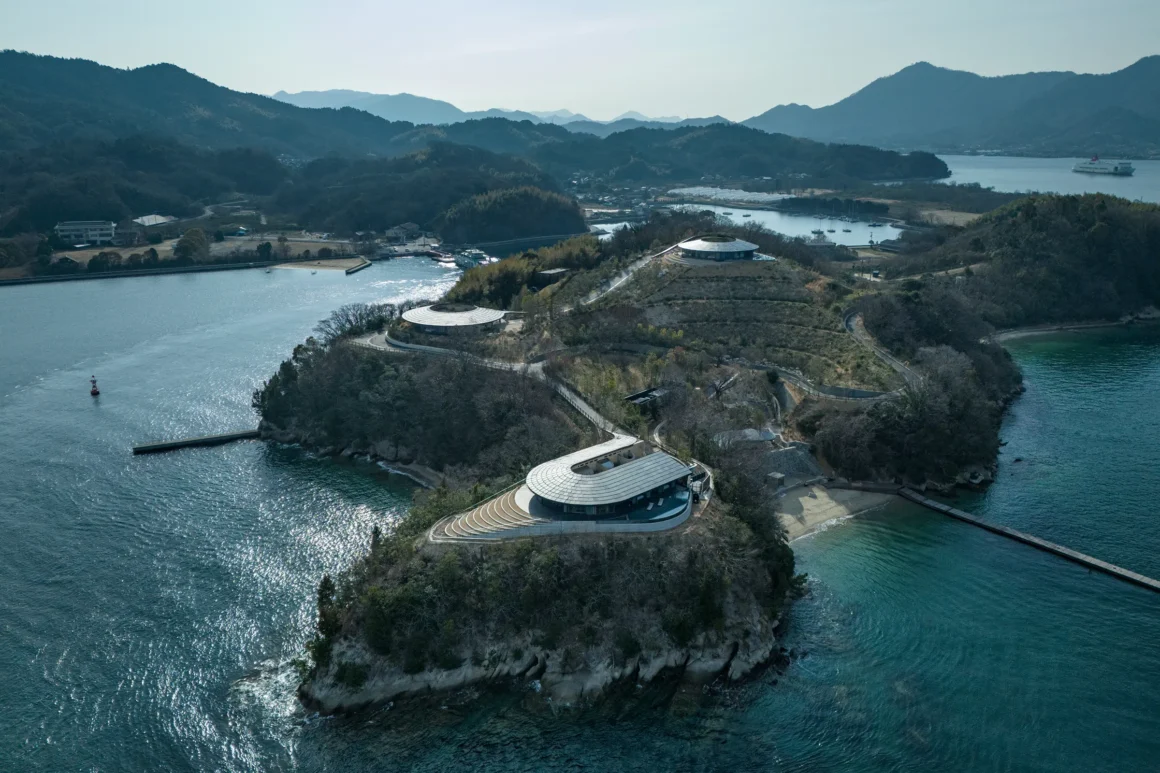
Architecture stories often arrive as renderings. This one arrived as an opening. NOT A HOTEL’s official release says NOT A HOTEL Setouchi began operations on April 1 on Sagishima Island in Hiroshima Prefecture, with three villas and a communal restaurant. BIG’s project page lists it as a completed hospitality project spanning 2,350 square meters, making it the studio’s first finished buildings in Japan.
NOT A HOTEL Setouchi opens as a designed journey, not just a stay
What makes this opening more interesting than a standard luxury-hospitality update is the way the arrival has been choreographed. NOT A HOTEL says guests and owners approach the property through a lounge, private boat transfers, and even helicopter access, while Terrace “90” functions as a beachside threshold before and after check-in. In other words, the experience starts before the villa door opens. That makes the project feel less like a hotel drop and more like a carefully staged transition into a different pace of life.


The angles do the storytelling
The three villas are named 180, 270, and 360 for the views they command across the Seto Inland Sea, while BIG describes the broader concept as a family of pavilions shaped around 90-, 180-, 270-, and 360-degree relationships to the landscape. The design language pulls from traditional Japanese single-story homes, but it does not freeze there. Official project materials describe rammed-earth walls made with local soil, glass facades that reinterpret shoji screens, and solar panels designed to resemble tiled roofs. The result is not nostalgic architecture. It is architecture trying to look native to the hillside while still reading as unmistakably contemporary.
Why Setouchi matters more than the architect’s name
This story feels stronger because the setting already carries real cultural weight. NOT A HOTEL presents Setouchi as a region shaped by art and culture, and that is not just marketing language. The official Setouchi Triennale site describes the festival as a major contemporary art event spread across the islands of the Seto Inland Sea, with about one million visitors over time.
The official Japan National Tourism Organization page for Setonaikai National Park adds another layer. It presents the area as a vast coastal landscape defined by islands, shoreline, contemporary art, and slow scenic movement.
That context does real work here. This is not just a famous architect designing a remote retreat. It is a hospitality project trying to connect itself to one of Japan’s most visually and culturally magnetic regions.
This is closer to ownable hospitality than a normal hotel launch
There is also a structural twist beneath the visuals. NOT A HOTEL says Setouchi was sold through its 1/36 shared-ownership model, and owners can exchange nights across the wider network. The property page also shows that the three villas are sold out, with four-bedroom layouts ranging from roughly 707 to 786 square meters total area depending on the residence. So while the opening looks like luxury travel news on the surface, it also signals a more hybrid model: part architecture statement, part members-style escape, part branded real-estate hospitality. That hybrid may be the real headline. It suggests that for a certain slice of high-end travel, the future product is not simply a room with better amenities. It is an entire landscape, arrival ritual, and ownership logic wrapped into one experience.
The strongest thing about NOT A HOTEL Setouchi is that it does not chase loud futurism. Instead, it bets on topography, silence, material texture, and cultural placement. That makes the project feel bigger than a beautiful opening. It feels like a reminder that some of the most memorable hospitality now starts by asking a different question: not how a building can dominate a place, but how a place can shape the building back.
➡️ Follow Poziwibe Lifestyle for more design-forward stays, architecture openings, and travel stories that feel worth discovering.

