
A major new Science study suggests advanced AI can read messy emergency-room data with surprising skill, but the real story is not replacing doctors. It is learning where machines may help humans see sooner.

Medicine has always carried a quiet kind of pressure: the first answer is not always the right one. In an emergency room, that pressure can arrive before the full picture does.
A new study published in Science is putting that tension directly in the spotlight. Researchers compared an advanced large language model from OpenAI’s o1 series with physicians across clinical reasoning tasks, including early emergency-room reasoning, likely diagnoses, and management planning. The study was published on April 30, 2026, under the title Performance of a large language model on the reasoning tasks of a physician.
The most interesting part is not simply that AI performed well. It is where it performed well: in uncertain, early-stage clinical moments, when doctors often have limited information and patient records are messy.
A test built around real clinical pressure
According to the research summary, the team evaluated the model against hundreds of physicians and earlier AI systems across six experiments. These included standardized clinical cases and a real-world study using randomly selected emergency-room patients at a major emergency medical center in Massachusetts.
Harvard Magazine reported that one part of the study used 76 emergency-room cases from a Boston hospital, testing the model at three points: initial triage, first physician contact, and later admission decisions. Reviewers then compared AI-generated assessments with those from attending physicians without knowing which was which.
That design matters. This was not a neat classroom quiz. The model had to work with the kind of fragmented electronic health record data that doctors often face in real care.
AI clinical reasoning showed its clearest signal early
Across the experiments, the model matched or exceeded human performance in diagnostic and management reasoning. Its advantage appeared strongest during early emergency-department triage, when clinicians have to make fast judgments from minimal information.
That is why this study feels bigger than another “AI beats humans” headline. In practice, a missed diagnosis can begin as a small possibility that does not get enough attention soon enough. A tool that can scan a messy chart and surface a serious possibility early could become a second set of eyes at the most fragile moment in care.
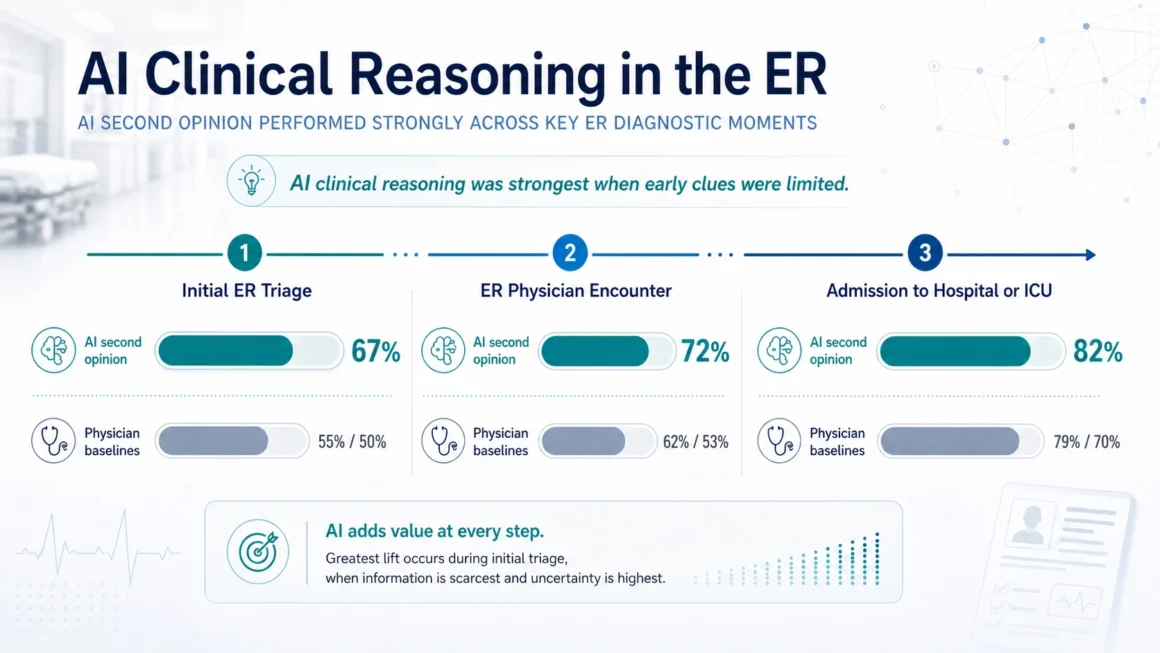
📸 Illustration created for Poziwibe based on Brodeur et al., Science 2026
Still, the researchers were careful about the limits. The study focused on text-based reasoning, while real medicine also depends on patient appearance, tone of voice, imaging, body language, physical exams, and clinical judgment.
Not a doctor replacement story
The researchers did not frame the results as proof that AI is ready to practice medicine alone. In fact, the authors and outside experts stressed the opposite: clinical AI still needs prospective trials, safety evaluation, equity checks, accountability, and human oversight before broader use.
That distinction is important. A model can identify a likely diagnosis and still suggest unnecessary tests. It can be impressive in a defined task and still fail in real-world deployment. Medical care is not only about being correct on a benchmark. It is also about responsibility, communication, trust, and deciding what to do when the answer is uncertain.
Science News also noted that researchers remain divided on how far these findings should be taken. Some experts see the study as rigorous and promising, while others warn that AI systems can still struggle with uncertainty and nuance, especially when multiple possible diagnoses remain on the table.
The future may be a partnership
The most realistic takeaway is not “AI doctor.” It is AI as a clinical partner that helps doctors catch what might otherwise be missed.
That could mean a passive system reviewing health records in the background. It could mean a second-opinion tool for complex cases. Or it could mean a new layer of decision support in emergency rooms, where time and uncertainty often collide.
For now, the study opens the door rather than closing the debate. It suggests AI is becoming powerful enough to deserve real clinical testing — not blind trust.
The human doctor is still at the center. But the room may soon include another kind of intelligence, one designed to notice patterns fast, ask uncomfortable questions, and help the right answer arrive a little earlier.
➡️ Follow Poziwibe Technology for more stories about the tools quietly reshaping everyday life.

