
The builder best known for Guinness-backed speed records is now chasing the opposite frontier. His latest Luke Bell solar drone stayed aloft for just over five hours, suggesting that the next meaningful drone leap may be less about going faster and more about staying useful for much longer.
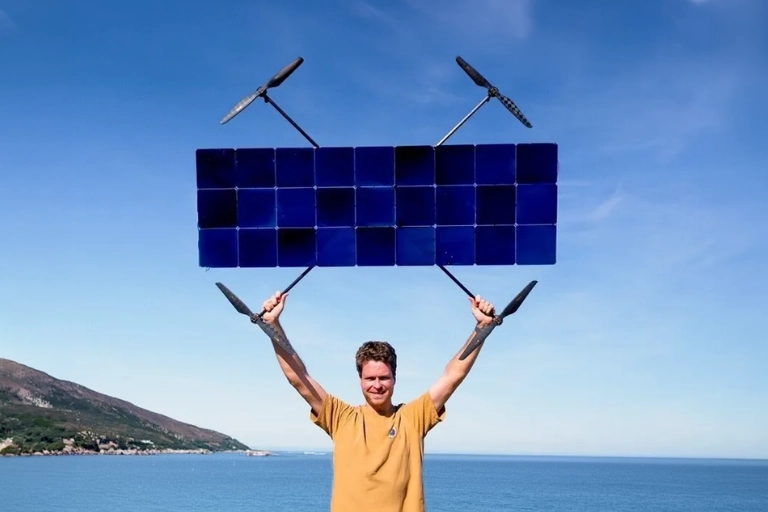
Most drone headlines reward violence of motion. They celebrate acceleration, top speed, and short bursts of technical excess. Luke Bell’s latest build flips that instinct. The real headline is not aggression. It is patience. Recent reporting on Bell’s newest solar project, alongside Bell’s own YouTube uploads, points to a flight lasting 5 hours, 2 minutes, and 21 seconds. That is especially notable in a multirotor format, where endurance usually collapses under the weight of ordinary battery limits.
From world-record speed to solar patience
Bell is not arriving at this story as a random tinkerer with a sunny-day experiment. Guinness says Luke Bell and Mike Bell currently hold the official record for the fastest battery-powered RC quadcopter at 657.59 km/h (408.60 mph), set in Cape Town on December 11, 2025. Meanwhile, Bell’s official YouTube channel now places projects like Creating the World’s Most Efficient Drone beside How Long Can a Solar Drone REALLY Fly?. That combination makes this solar build feel less like a novelty stunt and more like a deliberate pivot from raw speed toward efficiency.
What the five-hour flight actually proves
This was not a magical battery-free machine that escaped physics. Bell’s earlier solar work aimed to fly directly from sunlight alone, but the more successful long-endurance version reportedly added a diode-based backup circuit and a small auxiliary battery. That matters. It means the aircraft could survive clouds, gusts, and sudden power spikes instead of simply falling out of the sky. Reports on the final setup say it used 28 solar panels and produced more than 110 watts on the ground, while hover demand sat closer to 70 watts in strong sun. Bell also framed the concept around practical use cases such as agriculture, mapping, mining, and surveillance, where extended air time can matter as much as peak performance.
Why this lands beyond hobby-drone culture
The broader signal is not that small solar quadcopters are suddenly ready to replace every commercial drone. It is that persistence is becoming the more interesting metric. Airbus says its fixed-wing Zephyr platform can fly continuously for months in the stratosphere, proving that solar endurance already works at the high end of aerospace. Bell’s drone attacks a different problem. Instead of living high above weather like a pseudo-satellite, it asks whether a smaller vertical-lift craft can stay useful closer to the ground, lift off from almost anywhere, hover when needed, and reduce the battery anxiety that limits so many everyday drone tasks.
The real limit is still the margin
That does not mean the problem is solved. Wind remains a serious weakness for a light, panel-heavy multirotor, and even favorable coverage of Bell’s test makes clear that the aircraft was operating close to its comfort zone. The five-hour result is also still unofficial, not a Guinness-certified endurance entry. Even so, that caveat does not weaken the story. It sharpens it. The deeper point is that one of the most interesting drone experiments of the moment did not come from a major defense contractor or a giant consumer brand. It came from a builder using YouTube almost like a public R&D notebook.
For now, Bell’s solar drone remains a proof-of-concept rather than a finished product. Still, it already reframes the conversation. Some of the most exciting drone progress now looks less like making quadcopters more aggressive and more like teaching them to linger with purpose.
➡️ Follow Poziwibe Technology for more stories where the real breakthrough is not louder hardware, but smarter engineering.

