
A radio signal from a galaxy merger more than 8 billion light-years away stayed strong enough to be measured, making it the most distant hydroxyl megamaser ever detected.
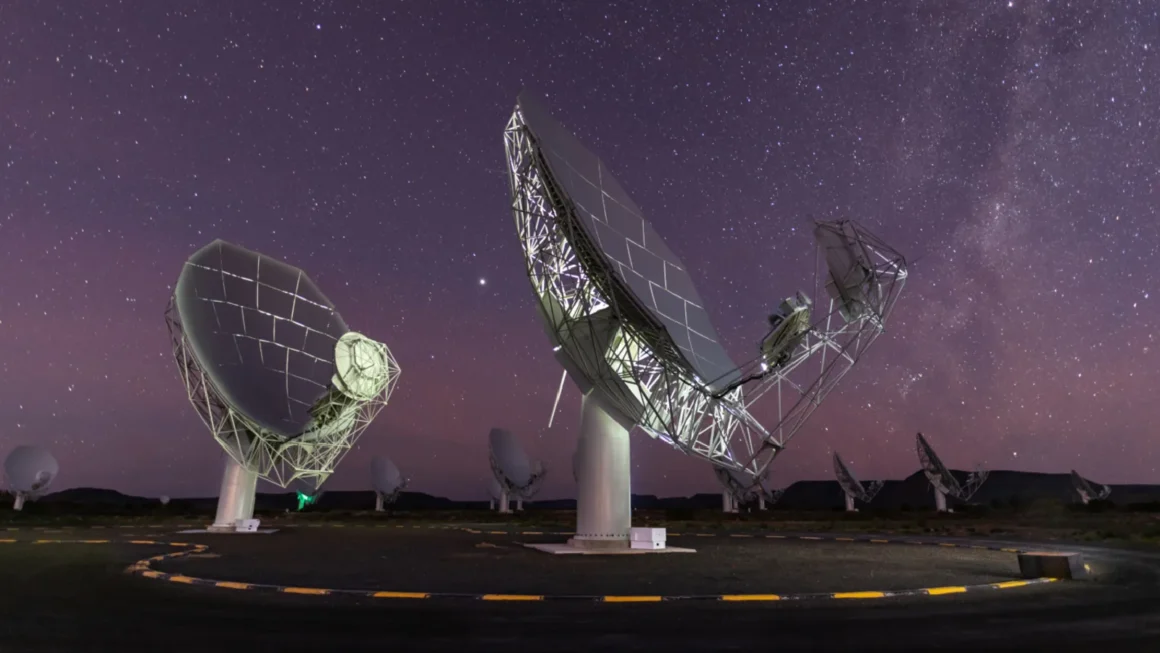
Astronomers detected the most distant hydroxyl megamaser and traced it to the lensed galaxy system HATLAS J142935.3–002836 at redshift z = 1.027. South Africa’s MeerKAT radio telescope captured the signal, and in observed terms, it appears to be the most luminous of its kind.
But distance alone does not explain the result.
At this range, signals usually fade into noise. This one stayed clear. The familiar hydroxyl lines near 1667 and 1665 MHz remained strong enough to measure. That turns this from a record into something more useful: a sign of how far radio observations can now reach.
Where the signal comes from
A maser works like a radio-frequency version of a laser. In this case, the signal comes from hydroxyl molecules inside a dense galaxy merger.
Galaxy collisions compress gas and accelerate star formation. They also create unstable, crowded environments. These are the exact conditions where strong hydroxyl megamaser emission can emerge.
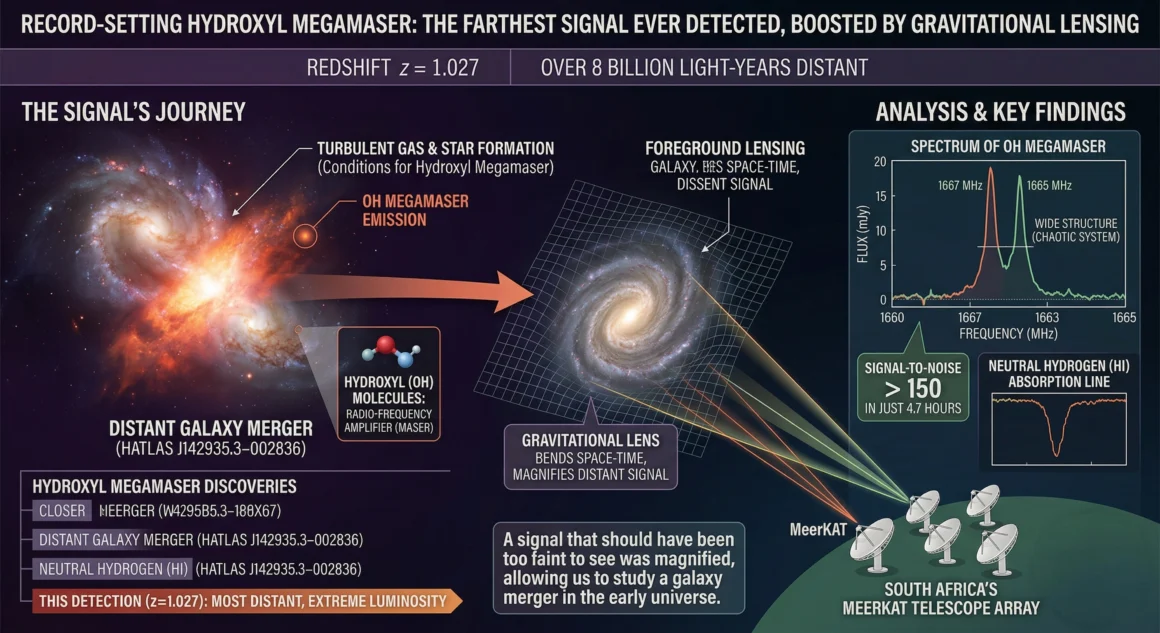
The source may sit near the upper edge of what astronomers classify as a megamaser. It could even approach gigamaser levels based on its brightness. Its spectrum reflects that complexity. Some features are narrow, while others stretch across hundreds of kilometers per second.
This is not a single clean spike. It is a structured signal shaped by a chaotic system.
Why this most distant hydroxyl megamaser stayed visible
Distance alone did not keep this signal detectable.
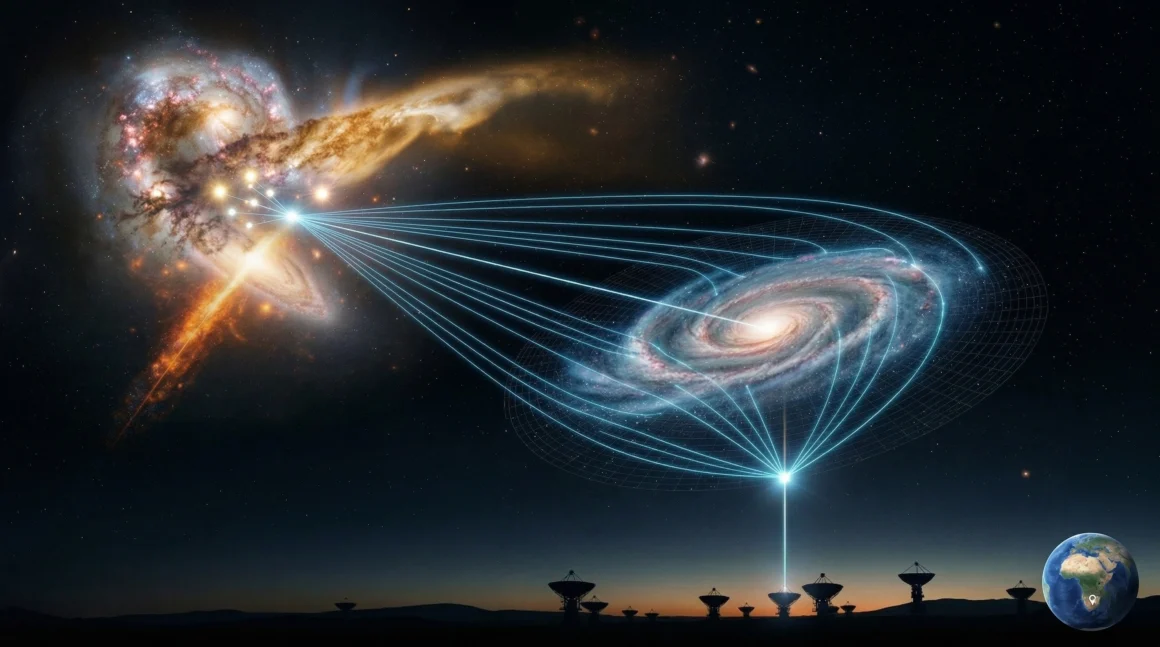
Gravitational lensing made the difference. A foreground galaxy bends space-time and magnifies the merger almost directly along our line of sight. That alignment boosts the signal.
The team measured a signal-to-noise ratio above 150 in just 4.7 hours. That level is unusual for a source this distant.
The same data also revealed a neutral hydrogen absorption line. This gives astronomers another way to study the gas inside the system.
Earlier hydroxyl megamaser studies focused on much closer galaxies. This detection reaches far beyond that range. That is the real shift.
Radio observations can now access a part of the universe that used to stay out of reach. A signal like this would have been too faint not long ago. Now it still holds its shape across billions of light-years.
➡️ Poziwibe follows Technology stories like this when a distant signal becomes something we can actually read.

