
Instead of launching another flashy chatbot feature, Google has released a low-key dictation app that cleans up messy speech on-device. That makes Google AI Edge Eloquent feel less like a novelty and more like a glimpse of where everyday mobile AI may actually become useful.
Google has quietly put that bet into the App Store with a new free iPhone dictation app. According to the official App Store listing, the tool is designed for iPhone and turns spoken thoughts into cleaner text. Google’s official AI Edge materials also place it inside a broader push toward local, privacy-aware mobile AI.
The interesting part is not dictation alone
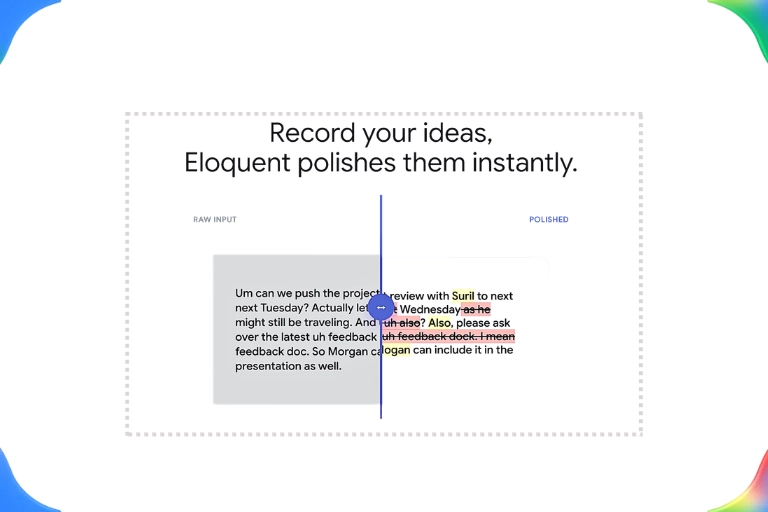
Plenty of apps already promise speech-to-text. What gives this one a sharper edge is the cleanup layer. According to the App Store description, Eloquent turns natural, messy speech into more polished writing by removing filler words, smoothing self-corrections, and capturing intended meaning instead of transcribing every stumble. The listing also says the app runs on Google’s Gemma architecture and uses on-device models for responsive speech-to-text without needing a server connection.
📸 Adapted from Google AI for Developers
That matters because it shifts the product from simple transcription into lightweight writing assistance. In other words, this is not just a note-taking tool. It is Google testing whether AI can become a more invisible part of how people draft, think out loud, and turn rough speech into usable prose on a phone. That framing is also consistent with Google AI Edge, which positions the broader stack around working offline, reducing latency, and keeping data local.
Why the offline layer changes the story
The most important signal here is the local-first design. Google’s AI Edge materials describe the platform as built to work offline, reduce latency, and keep data local and private. Meanwhile, the Eloquent app description says machine learning processing runs locally on-device, while noting that some advanced optional features can use the cloud. TechCrunch separately reported that users can switch cloud mode off, and that when cloud mode is on, Gemini models help with text cleanup.
That combination gives the product a more grounded kind of appeal. It does not ask users to trust a vague AI promise. Instead, it offers a concrete workflow: speak, clean, save, move on. That is a much easier habit to adopt than opening a chatbot every time you need help writing something small.
The bigger signal may be where Google thinks AI belongs
There is another reason this launch stands out. The App Store description talks about future-style Android conveniences such as default keyboard access and a floating button, even though the current live release is on iPhone. That suggests Google may be treating Eloquent as more than a single app. It looks more like an experiment in placing AI closer to the system layer, where it can support everyday writing rather than interrupt it. That last point is an inference, but it is grounded in the app’s description and in Google’s wider push around cross-platform edge AI.
If that direction holds, the real story is not that Google made a dictation app. It is that Google seems increasingly interested in AI that feels quiet, personal, fast, and useful before it feels impressive. On phones, that may be the smarter path. Not every meaningful AI product needs to announce itself like a breakthrough. Some of them just need to save people a few minutes, preserve privacy, and make rough thoughts easier to keep.
➡️ Follow Poziwibe Technology for more AI stories where the real shift is not the hype, but how the product may quietly change everyday behavior.

