
A rare birth off Dominica revealed something even more striking than the newborn itself. Adult females closed in around the mother, then helped the calf rise, breathe, and stay with the group.
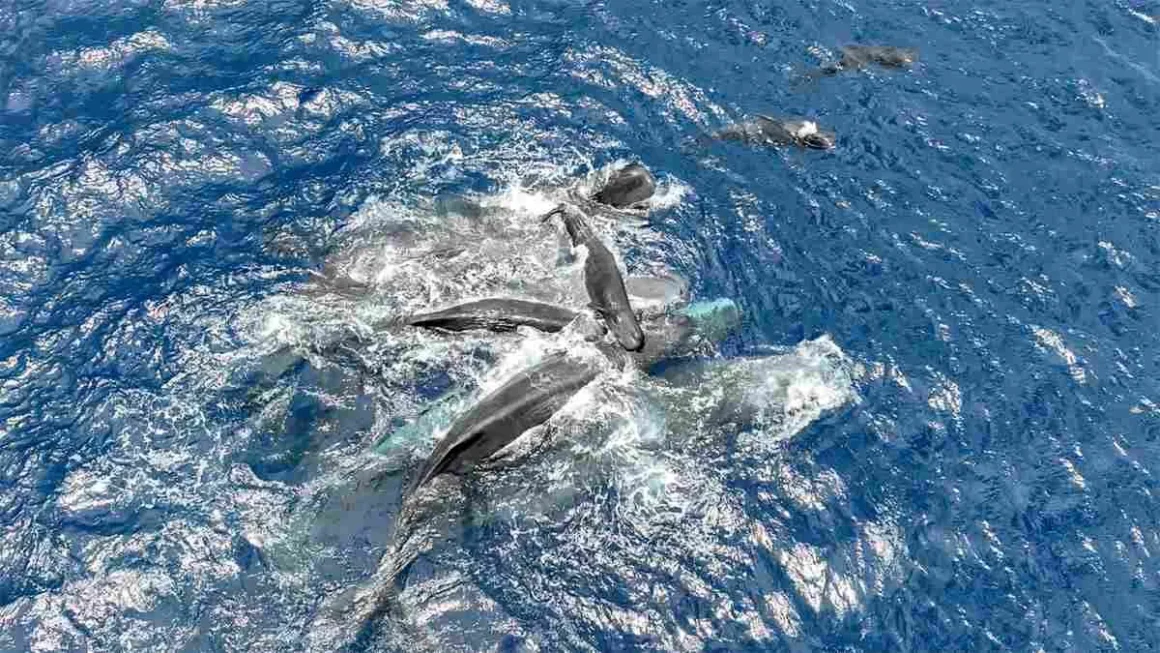
For a newborn sperm whale, the first minutes can turn dangerous fast. Researchers found that newborn sperm whales can be negatively buoyant at birth. That means a calf can sink before it gains control in the water. In this case, adult females helped lift the calf toward the surface soon after birth.
The group did not just watch
This was not a loose gathering. Project CETI documented 11 sperm whales from Unit A during the encounter off Dominica. The team described a tight formation before birth and coordinated support after it. CETI’s own project materials frame the moment as a case of collective attentiveness around the pregnant female and the newborn.
Help came from more than close family
The social detail makes this story much stronger. Harvard’s summary of the research says females from two unrelated matrilines helped during the birth. Both kin and non-kin took turns assisting the newborn. That turns the event into more than a rare wildlife sighting. It becomes evidence of cooperative birth support beyond the closest family line.
The footage revealed a social system under pressure
Rare footage can grab attention. However, the deeper value here is what the footage shows about sperm whale society. These whales did not simply surround the mother. They responded together in a high-stakes moment. Project CETI also paired drone footage with synchronized analysis tools to study the event more closely.
Why this matters beyond one rare moment
The scientific value is unusually high. The Scientific Reports paper says there has been only one previous scientific observation of a sperm whale birth in the last 60 years. That makes this event rare on its own. Yet the real significance goes further. It gives researchers a clearer look at how sperm whales coordinate care when a newborn needs immediate help.
Dominica is part of the story too
This moment did not happen in isolation. Project CETI’s research program is rooted in Dominica and focuses on sperm whale communication, behavior, and long-term observation. That setting gives the story more depth. It connects one remarkable birth to a larger effort to understand one of the ocean’s most socially complex species.
A lot of animal stories stop at rarity. This one does not. What makes it memorable is the shared response. A calf entered the world, and a whole circle of whales seemed to know exactly what to do. That makes the moment feel less like spectacle and more like a glimpse into a society that still has much to teach us.
➡️ Follow Poziwibe Nature for more stories where animal behavior reveals a deeper kind of intelligence, cooperation, and survival.

