
Xiong’an’s master plan becomes much more interesting at ground level: in 15-minute routines, wetland recovery, controlled density, and the harder question of whether a city built for the 2030s can actually make ordinary life feel easier.
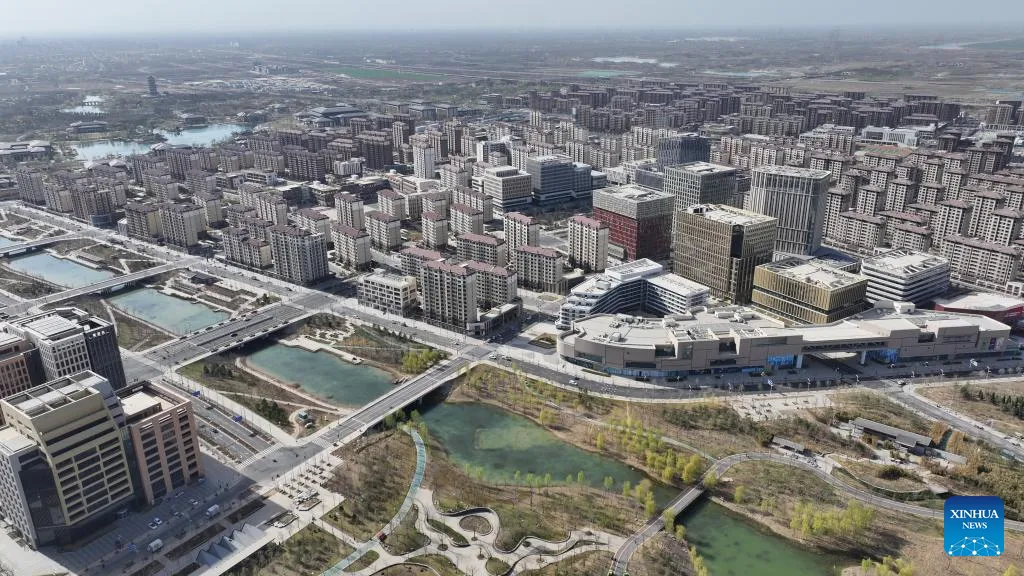
China’s 2018 master plan for Xiongan New Area did not present the project as just another district of tall buildings. Instead, it mapped the area to 2035 as a green, intelligent, livable city about 100 kilometers southwest of Beijing. The goal was to take on noncapital functions and test a different urban model. Read that way, Xiong’an works best not as a grand symbol but as a daily-life experiment: what does a city built almost from scratch for the 2030s actually look like when real people need to get to school, reach care, move around, and spend less time fighting the city? That question matters even more because the project is still unfinished. Recent outside reporting notes that central Xiong’an remains relatively sparse, even as basic completion is still targeted for 2035.
The plan is stricter than the skyline suggests
The interesting part is how deliberately the design tries to limit the usual excesses of fast urban growth. The 2019 approved development plan says green land and clean water should make up 70 percent of the area, while overall development stays within 30 percent. It also discourages high-rises and prohibits large-scale commercial real estate. Instead, the plan ties livability to public services, low-carbon systems, and faster rail-and-road links, not just visual spectacle. The earlier 2018 master plan pointed in the same direction. It emphasized capped land intensity, a 40 percent forest-coverage target, and faster trips to Beijing, Tianjin, and Daxing Airport. That makes Xiong’an less a skyline story than a friction story.


A 15-minute city is really a daily-routine city
The clearest everyday clue is the 15-minute logic. An official 2025 update says parks, schools, recreational facilities, and convenience stores are meant to sit within a 15-minute walk. It also quotes a resident describing a five-minute walk to kindergarten and another short walk to work. A more technical planning analysis describes six 15-minute living zones in the initial area, organized around public-transport transfer, education, health services, cultural space, fitness, and care for older adults. In other words, the project is not only trying to look future-ready. It is trying to make the small, repeated tasks of life shorter, calmer, and less car-dependent.
The green promise only matters if it feels lived
That is also why the ecological layer matters so much. Xiong’an sits beside Baiyangdian, one of northern China’s major wetlands. So the city’s green promise cannot mean decorative parks between buildings alone. It has to mean real restoration. An official Baiyangdian restoration update said lake water quality had improved to its best level since monitoring began in 1988, after previously falling to the worst grades. The later 2025 official update said forest coverage had risen from 11 percent to 35 percent. It also said Baiyangdian was home to 295 wild bird species, up by 89 from before the new area was established. That does not just make Xiong’an look greener. It suggests the city is trying to build credibility through water, shade, habitat, and breathing room rather than branding alone.


Why the unfinished state is part of the story
None of that means the experiment has already passed. It means the right test is finally visible. A future city is easy to sell in aerial photos. It is much harder to prove in school drop-offs, clinic access, care for older adults, commute reliability, walking comfort, and the question of whether restored wetlands can coexist with large-scale growth. That is what makes Xiong’an worth watching from an urban-design angle. The real test of a future city is not whether the skyline looks new. It is whether daily life feels less crowded, less polluted, and less time-consuming than the cities it hopes to improve on.
➡️ Follow Poziwibe Lifestyle for more stories about future cities, smart mobility, and how design shows up in everyday life.

