
The latest NASA mission events update still lists Artemis II for no earlier than April 1, 2026, at 6:24 p.m. EDT, with additional launch opportunities running through April 6. That keeps the schedule relevant. However, the more interesting story now is not the calendar alone. It is the mission profile itself. Artemis II is shaping up as a clearly defined 10-day crewed lunar flyby, designed to show the public exactly how NASA plans to move from launch, to deep-space checkout, to a loop around the Moon, and finally back to Earth.
That shift matters because NASA’s Artemis II mission page frames the flight as the first crewed Artemis mission and a key step toward long-term return to the Moon and future missions to Mars. In other words, Artemis II is not just a launch headline. It is the first full human run through the route, timing, systems behavior, and operational rhythm that later Artemis missions will build on.
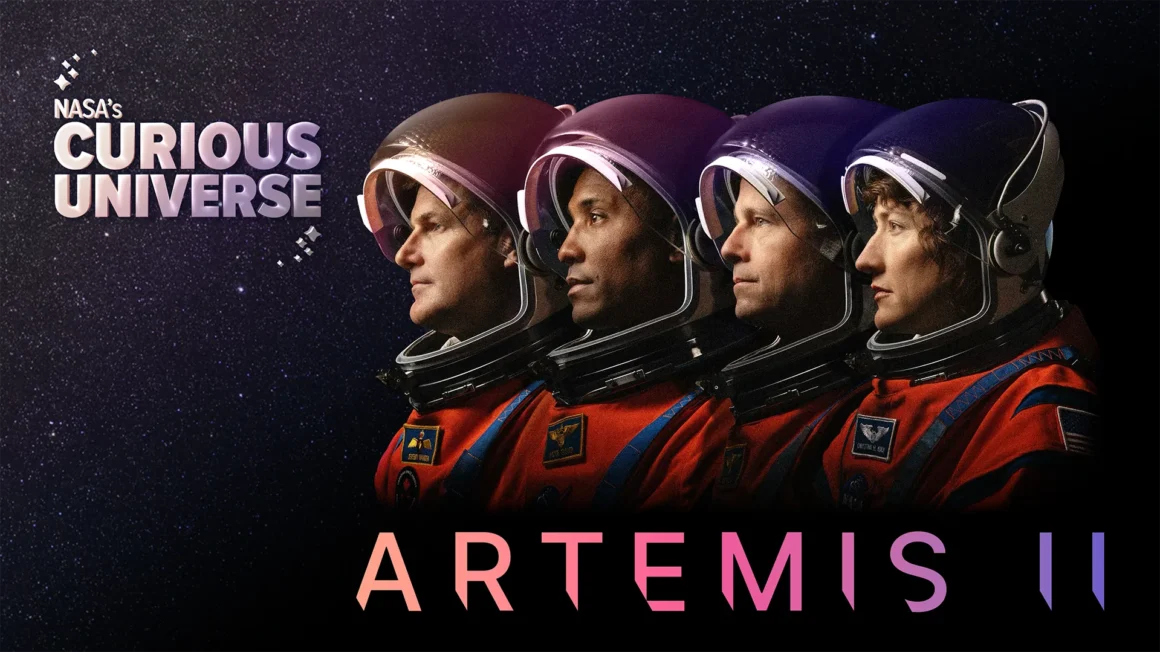
The Schedule Update Is Context, Not the Main Event
NASA did need to resolve a real technical issue during final preparations. In its March 3 update, the agency said engineers found that a seal in the quick disconnect was blocking helium flow to the upper stage.
Teams removed the hardware, reassembled the system, and started validation work. NASA also said technicians were refreshing other systems at the same time. Those included batteries and a seal on the core stage liquid oxygen line feed system.
That context matters. Still, it should not dominate the story. The bigger question now is simple: what will Artemis II actually do once it leaves Earth?
What Happens in the First 24 Hours
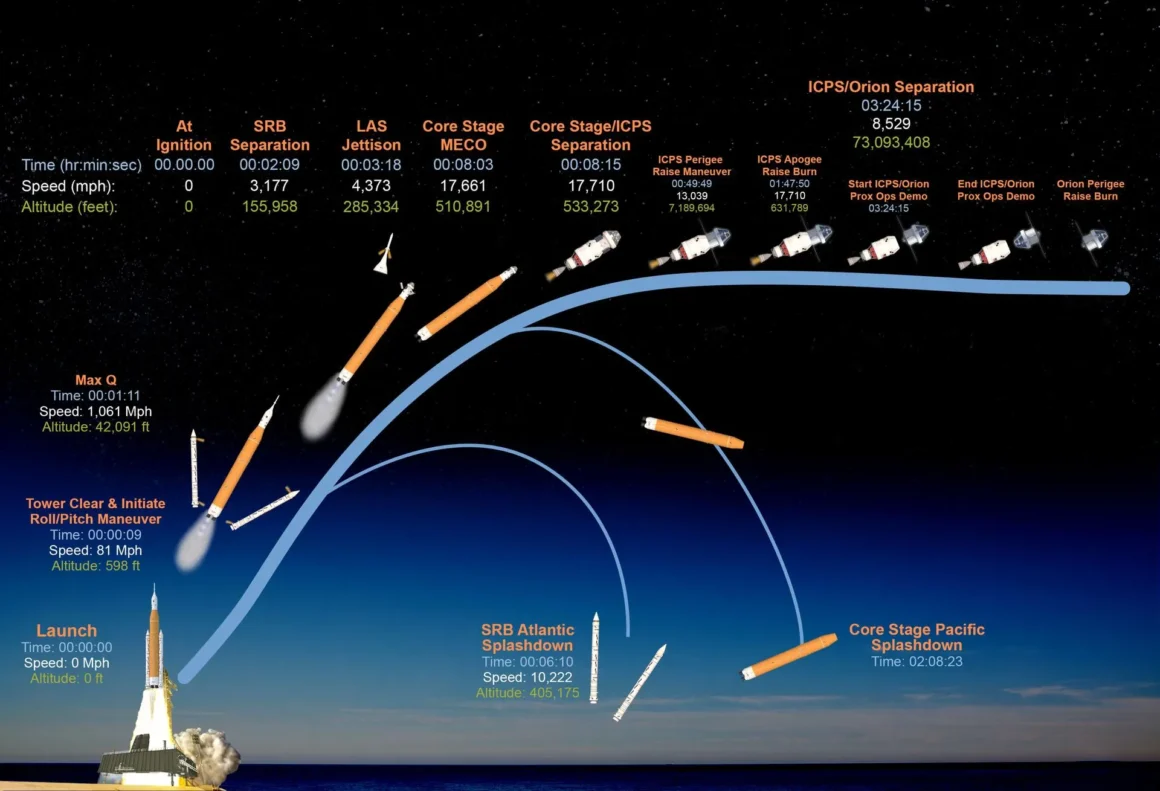
According to NASA’s Artemis II daily agenda, the mission begins with more than a straight shot into deep space. After the SLS main engines cut off, Orion and the interim cryogenic propulsion stage separate from the rest of the rocket.
Then, about 49 minutes after launch, the upper stage performs a burn that raises Orion’s perigee. About an hour later, it fires again and continues raising the spacecraft into high-Earth orbit.
From there, the crew gets about 23 hours to complete a full Orion checkout while still relatively close to home.
Why That Early Phase Matters
That first stretch is more revealing than it sounds. NASA says the astronauts will test practical onboard systems such as the water dispenser, the toilet, and the equipment that removes carbon dioxide from the cabin air.
They will also start turning Orion into a temporary home and workspace for four people in deep space. In addition, around three hours into the mission, NASA will run a proximity operations demonstration. During that test, the crew will use the upper stage as a target and rehearse how Orion approaches and maneuvers around another spacecraft.
So the mission begins as a serious systems rehearsal, not just a dramatic departure.
How Orion Commits to the Moon
On flight day 2, Artemis II reaches the moment that makes the mission feel truly lunar. NASA says Orion performs its translunar injection burn, the last major engine firing of the mission.
That burn puts the spacecraft on a free-return trajectory. In simple terms, Orion will swing around the far side of the Moon and then naturally head back toward Earth later in the flight.
Before that step, the crew also performs a brief emergency communications checkout on the Deep Space Network. That detail matters too. Artemis II is not only about movement through space. It is also about proving the communications backbone behind the mission.
What Happens on the Way to the Moon
The days after translunar injection turn Artemis II into a readable sequence instead of a vague idea. NASA’s agenda says flight days 3, 4, and 5 include outbound trajectory correction burns, crew checkouts, emergency communications work, and preparation for the observations the astronauts will make near the Moon.
By flight day 5, Orion enters the Moon’s sphere of influence. That is the point where lunar gravity becomes stronger than Earth’s pull.
NASA also plans spacesuit testing that day. The crew will check the new Orion crew survival system suits and practice how quickly they can don and pressurize them in an emergency.
What the Lunar Flyby Will Actually Feel Like
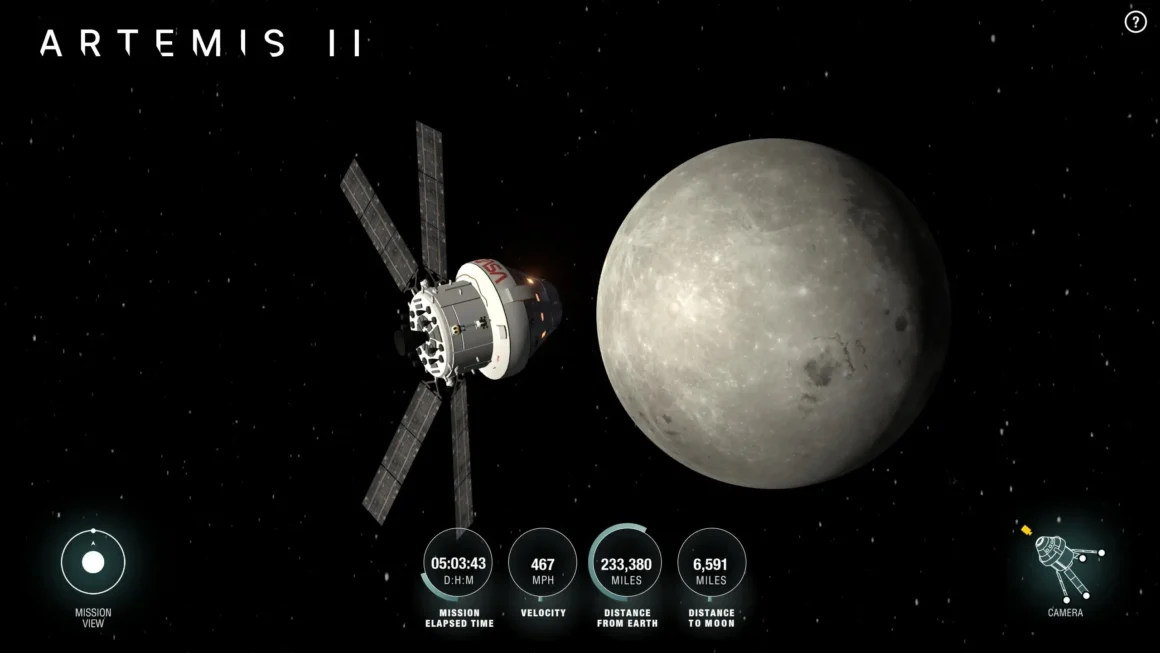
The emotional center of the mission arrives on flight day 6. NASA says the crew will come closest to the Moon that day while also traveling farthest from Earth.
Depending on final launch timing, Artemis II could even break the Apollo 13 distance record, which is currently 248,655 miles from Earth. NASA also says Orion is expected to pass within roughly 4,000 to 6,000 miles of the lunar surface as it swings around the far side of the Moon.
That is where the mission becomes bigger than a launch update.
NASA says the crew will spend much of the day taking photos and videos of the Moon and recording observations in real time. As Orion passes behind the Moon, communications with Earth are expected to cut out for about 30 to 50 minutes.
That blackout helps give Artemis II its real deep-space feel. This is not a symbolic flyby. It is a crewed mission moving through distance, silence, timing, and operational constraint.
How the Mission Returns Home
The return sequence is just as structured. On flight day 7, Orion exits the lunar sphere of influence and begins its trip back with the first of three return trajectory correction burns.
On flight day 8, the crew is scheduled to test radiation-shelter procedures using supplies and equipment inside Orion. That detail speaks directly to the realities of human deep-space travel.
Then, on flight day 10, Orion heads into Earth’s atmosphere for reentry and splashdown in the Pacific Ocean.
How Splashdown Works
NASA’s daily agenda also gives the landing sequence concrete detail. After reentry, Orion’s forward-bay cover is jettisoned so the parachute system can deploy.
NASA says two drogue parachutes slow the capsule first. Then three pilot parachutes pull out the final three main parachutes.
Together, those reduce Orion to about 17 mph for splashdown, where NASA and U.S. Navy personnel will be waiting.
That level of specificity matters. It makes Artemis II feel less like a concept and more like a mission readers can follow from start to finish.
Why Artemis II Feels Easier to Follow Now
One reason this mission is becoming more legible is that NASA has published an unusually helpful public resource trail. The agency’s Artemis II media resources hub collects the press kit, mission overview, April 1 launch timeline, official Artemis blog, flight path animation, mission images, and launch-to-splashdown animation in one place. That means readers no longer have to piece the mission together from scattered headlines. They can study the route directly from NASA’s own ecosystem.
NASA has also built a public tracking layer around the mission. On the AROW real-time tracker page, the agency says users will be able to follow Orion’s position relative to Earth and the Moon, track key milestones, and watch mission data such as velocity and distance. That turns Artemis II into a story with live spatial logic. It is not just “launch, then wait for headlines.” It is a mission the audience can watch unfold as a moving path.
Why the Bigger Artemis Vision Still Matters
Artemis II will not land on the Moon. Even so, it still carries the wider Artemis program forward in a meaningful way. NASA’s mission page describes Artemis II as a key step toward long-term lunar return and future Mars missions, which makes this flight feel like a bridge between ambition and execution. It is the mission where the route itself becomes credible.
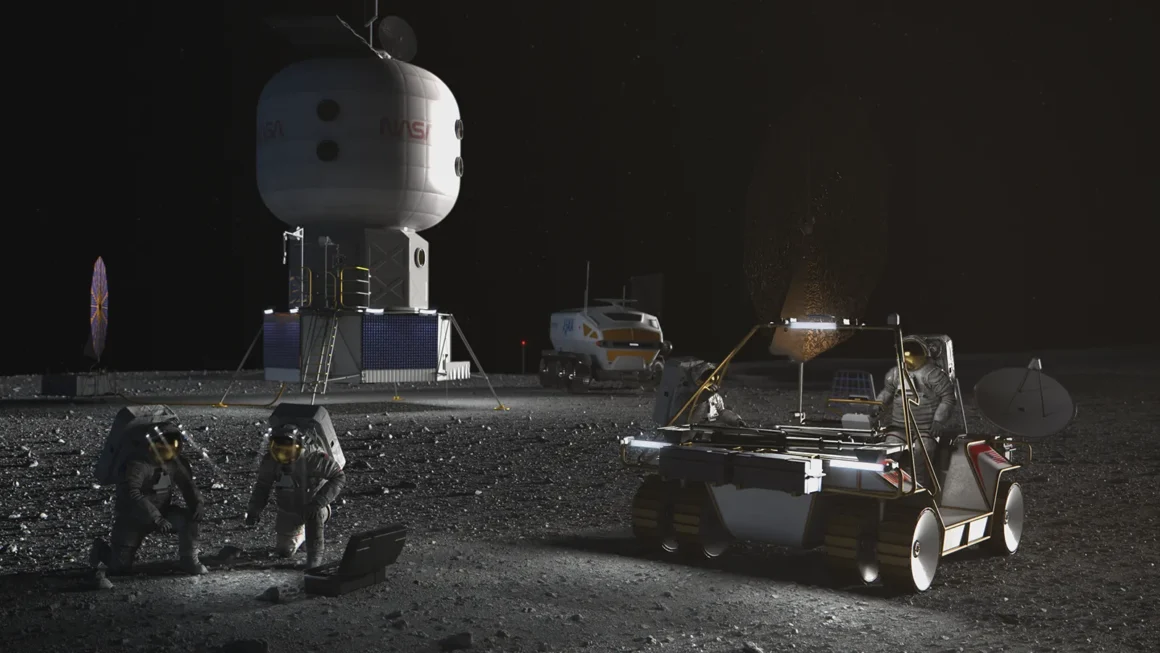
That is also the right place to understand the broader lunar imagery around Artemis. Surface habitats, rovers, and longer lunar stays belong more to the program’s future architecture than to Artemis II specifically. Still, they help show what this mission is helping prepare for: a future in which crewed missions beyond low Earth orbit become repeatable, testable, and operational instead of purely aspirational.
A Small Symbol Makes the Mission Feel More Human
NASA has also given Artemis II a small emotional marker that makes the mission feel more personal. The crew will fly with “Rise,” a plush zero gravity indicator designed by Lucas Ye of Mountain View, California.
According to NASA, the design was inspired by the iconic Earthrise moment from Apollo 8. That choice fits this mission especially well.
Artemis II is built around systems, timing, trajectory, and trust. Yet “Rise” adds a softer reminder of what those things are really for: carrying human beings far enough from Earth to see home differently again. That reading goes slightly beyond NASA’s basic description, but it fits the symbolism NASA highlighted when it linked “Rise” to Apollo 8’s Earthrise moment.

Artemis II still targets April 1 launch. Yet the strongest version of the story is no longer the date alone. It is the fact that NASA has made the mission’s sequence visible: Earth orbit checkout, translunar injection, lunar flyby, return corrections, reentry, and splashdown. For readers, that is the real update. The mission now feels less like a distant promise and more like a route you can actually understand.
➡️ Follow Poziwibe Technology for more stories where the most exciting part is not just the destination, but the moment a complex mission becomes clear enough for everyone to follow.

