
A light-sensitive protein in birds’ eyes may help them respond to Earth’s magnetic field, offering a new way to understand how migration actually works.
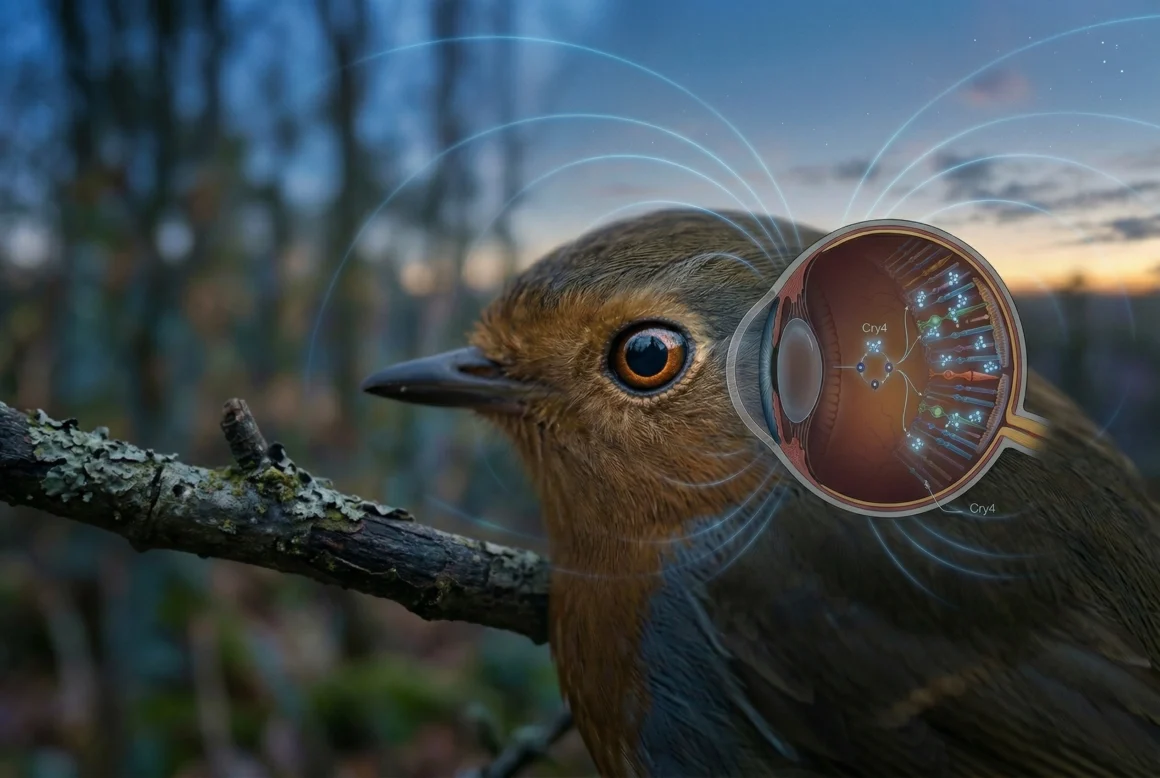
Bird magnetic field navigation is one of nature’s most precise and least understood abilities. Birds cross continents with accuracy, often returning to the same place year after year, as if they’re following something invisible.
That “something” may not be instinct alone.
Researchers increasingly believe that part of this ability comes from a light-sensitive process inside the eye, where certain proteins respond to Earth’s magnetic field. This idea is central to how scientists now approach bird magnetic field navigation.
It may begin with a molecule called Cry4
Inside a bird’s retina, a protein known as Cry4 responds to light — especially blue wavelengths. When it’s activated, it triggers a tiny chemical reaction called the radical pair mechanism.
That reaction is unusually sensitive.
Its outcome can shift depending on the direction of Earth’s magnetic field, which means it may carry directional information.
Not as a map. Not as coordinates. More like a subtle internal reference.
Bird magnetic field navigation may not be visual in a literal way
It’s tempting to imagine birds seeing magnetic lines across the sky. That’s not what the science shows.
What researchers suggest is quieter — and more grounded.
The magnetic field may gently influence how birds perceive direction, especially under certain lighting conditions. It doesn’t appear as an object. It shapes orientation.
That distinction matters. It keeps the idea credible while still leaving room for how unusual the mechanism is.
A familiar behavior with an unfamiliar explanation
Migration is one of the most familiar patterns in nature. But the way it works may depend on something far less familiar.
The radical pair mechanism operates at a level where extremely small changes matter — a space usually associated with quantum behavior.
That means a bird crossing an ocean may be guided, in part, by a process where light, chemistry, and magnetic fields quietly interact inside the eye.
No signal you can see. No map you can hold. Just sensitivity.
Still unfolding, not fully settled
Cry4 and the radical pair model are among the strongest explanations available today. But they are not the final word.
Different species may rely on multiple systems. Conditions like light and environment likely change how the mechanism behaves. And exactly how birds experience this information — if they experience it visually at all — is still being studied.
Migration no longer looks like instinct alone. It looks like a system — one we are only beginning to understand.
➡️ Explore more Nature stories that reveal how the natural world works in ways we are only beginning to understand.

