
French Navy seabed tests off southern France did not just detect an anomaly. They revealed Camarat 4, an exceptionally deep 16th-century wreck that shows how sonar, robotics, and digital mapping are changing what underwater history can look like.
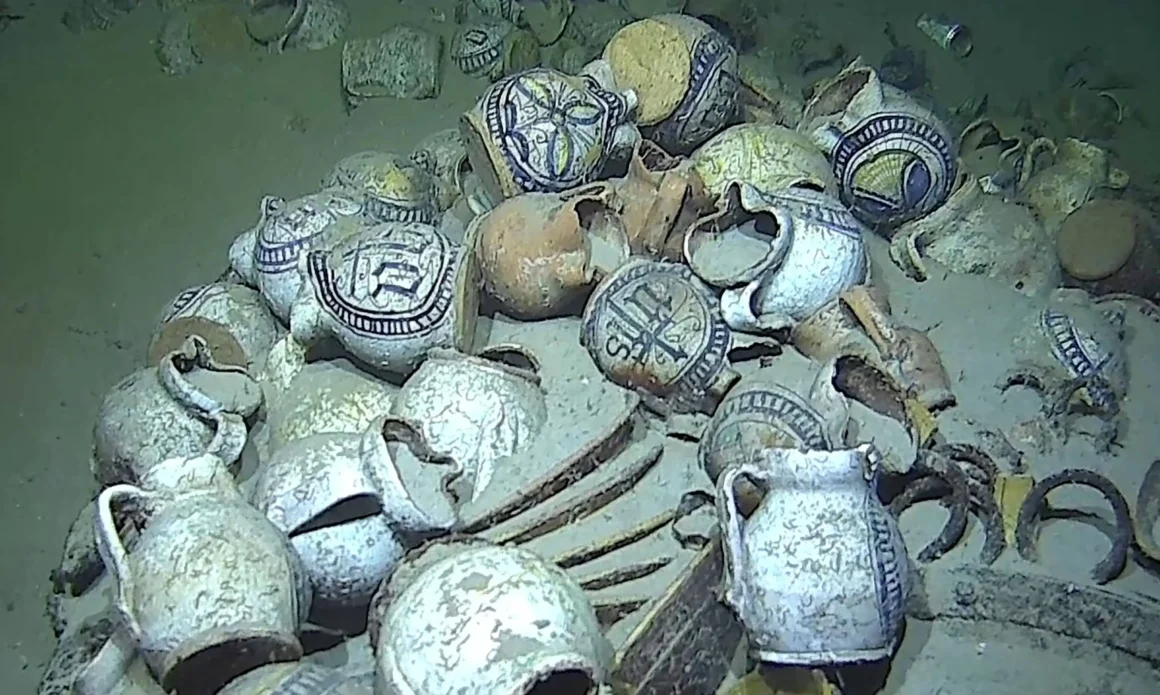
Part of the ceramic cargo at the Camarat 4 shipwreck site.
A shipwreck story usually begins with the past. This one begins with a signal. During deep-sea equipment tests off Ramatuelle in 2025, a sonar-equipped French Navy underwater drone picked up the shape of a wreck. Archaeologists at France’s Ministry of Culture then checked the national underwater heritage database and found no known wreck of that type recorded in the area. The Navy followed with a robot able to descend to 4,000 meters, capturing a short color scan that gave researchers their first real look at the site. What emerged was not just another find, but the deepest known wreck yet identified in French territorial waters.
Camarat 4 Feels More Like Decoding Than Diving
That shift is what makes this story feel fresh. Camarat 4 was not “found” because someone saw timbers through clear water. It was found because the seafloor was read as data first. France’s underwater archaeology service, Drassm, exists precisely for that overlap between heritage and modern detection systems. The ministry describes it as a national service equipped for underwater exploration, robotics, and deep-sea archaeological work, with the Alfred Merlin serving as its main research vessel in the Mediterranean.
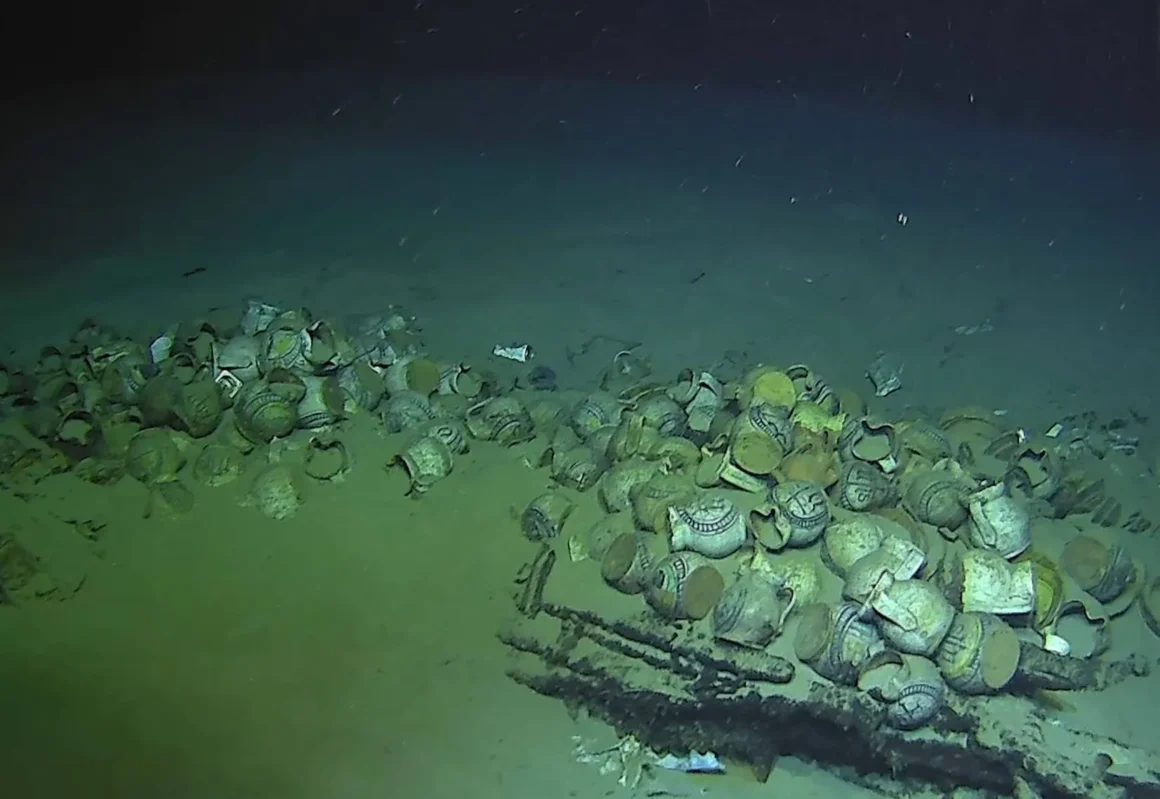
Ceramic cargo at the Camarat 4 wreck site.
The site lies at 2,567 meters below the surface. That depth changes the emotional shape of the story. It helps explain why the wreck appears so strikingly intact, and it also moves the find out of the usual treasure-hunt frame. According to the Ministry of Culture interview, researchers can already see a mound of intact 16th-century Ligurian ceramic jugs and around one hundred neatly stacked plates, details that suggest the sinking may have been relatively slow rather than explosively violent. The wreck does not look dramatically shattered. It looks paused.
The seafloor preserved more than one timeline
There is another layer here that feels very Poziwibe. The same official account that describes this remarkably preserved cargo also notes something much newer on the seabed: modern macro-waste. The ministry says the images showed soda cans, water bottles, and snack packaging even at that extreme depth. So the site carries two timelines at once: a 16th-century maritime route and a modern pollution trail. That contrast makes the wreck feel less like a romantic relic and more like a brutally honest cross-section of human presence at sea.
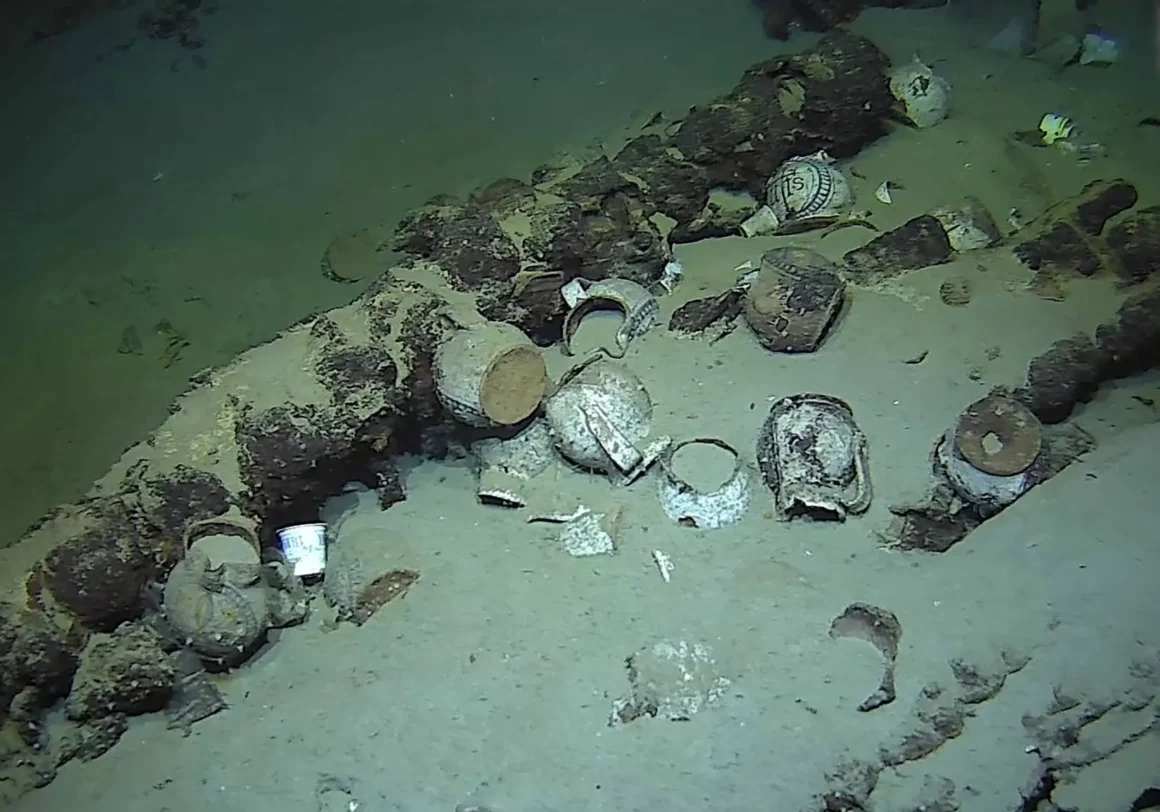
Ceramic cargo and wreck remains at the Camarat 4 site on the seafloor off Ramatuelle.
What happens next is careful technology, not dramatic recovery
French officials are not presenting Camarat 4 as a spectacle to haul back to the surface. They are describing a slow, highly technical process. The Ministry of Culture says the goal is to begin with a photogrammetric survey using thousands of images to build a 3D model of the site, potentially by the end of 2027. Officials also stress that there will be no full recovery of the wreck and no exhaustive excavation with current capabilities. Early sampling, if it happens, would be limited and carefully prepared.
That caution is partly technical. In the same interview, Drassm explains that its own robot Arthur reaches about 2,500 meters, which leaves Camarat 4 just beyond its comfortable range. That is why potential collaboration with the French Navy and Ifremer’s Ariane system matters so much. This is a story about archaeology, yes, but it is also a story about whether our tools have finally become precise enough to treat the deep sea as a readable archive rather than a black box.
The most interesting thing about Camarat 4 may be that it does not just tell us something about a ship. It tells us something about how the present is learning to approach the deep ocean. A sonar ping became a historical lead. A robot turned distance into evidence. And a wreck that sat beyond human reach for centuries suddenly became legible without needing to be destroyed to be understood. That makes this feel less like a shipwreck story than a breakthrough in how history is now being found.
➡️ Follow Poziwibe Technology for more stories where robotics, mapping, and discovery change how we understand the world.

