
A new lab-built hot spring model didn’t show life suddenly appearing on early Earth. It changed something narrower and more useful: scientists can now test origin-of-life chemistry in a system that behaves more like a real hot spring field, not just a single isolated pool.
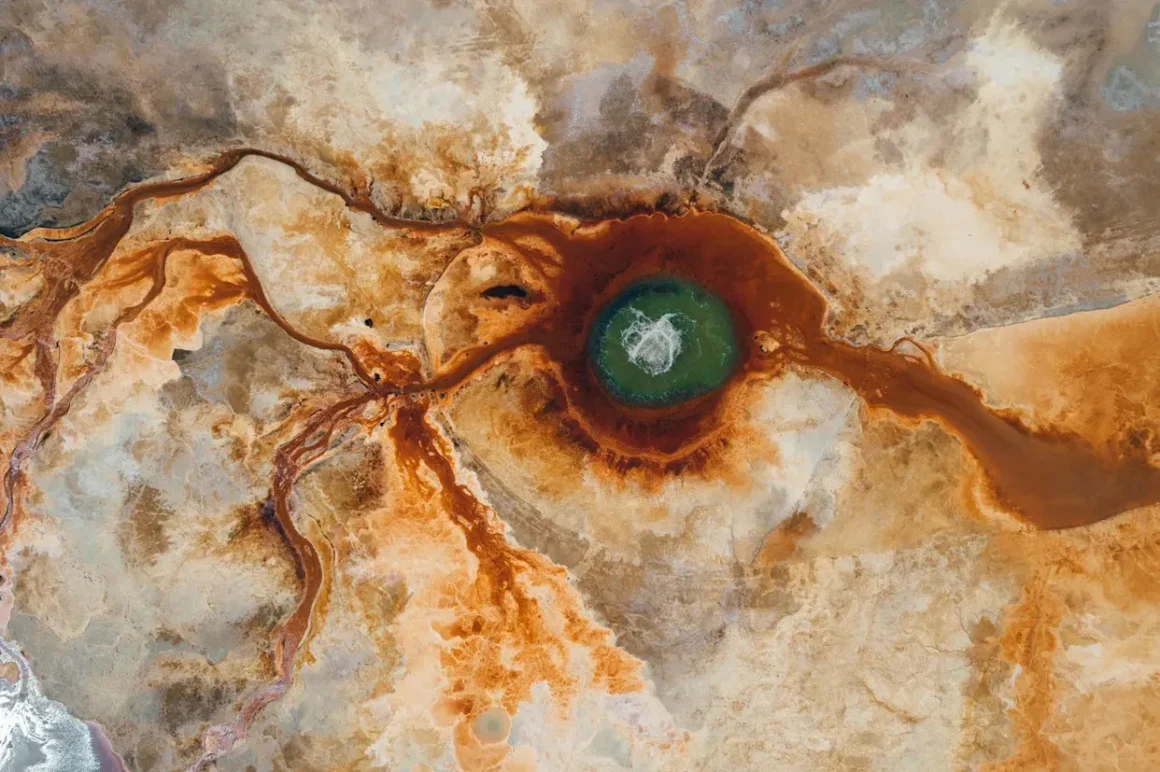
The hot spring model comes from a new preprint by researchers including scientists at UNSW and Curtin-affiliated teams. They built a modular 3D-printed setup with linked pools that can vary in temperature, pH, mineral conditions, fluid mixing, and wet-dry cycles. That may sound technical, but the shift is simple. Earlier experiments often reduced the hot spring idea to one pool. This one starts to look more like an actual landscape.
That matters because the hot spring hypothesis has always depended on changeable environments. The broader idea, laid out in earlier work on the origin of life, is that volcanic hot spring fields may have helped simple molecules concentrate, cycle, and assemble into more organized structures through repeated drying and rewetting.
The experiment got more realistic
In the new setup, researchers ran repeated wet-dry cycles across connected pools rather than inside one container. Inside that system, lipid vesicles formed spontaneously. These are tiny membrane-bound compartments often treated as a plausible step on the road toward protocells. The team also reported encapsulation of organic matter inside those membranous structures, with some vesicle types appearing better at trapping cargo than others.
That does not mean scientists created life. The paper does not claim that. What changed is the testing ground. The hot spring model now gives origin-of-life research a more Earth-like setting to work inside. It introduces unevenness, gradients, and interaction between pools, which is closer to the kind of chemistry a real hydrothermal field would produce.
Smaller claim, stronger footing
This is the kind of progress that tends to get overstated when it leaves the lab. It is not a final answer to where life began. It is a better way to ask the question.
That is why the study lands well. Instead of making the theory bigger, it makes the model tighter. The system is modular, so future experiments can change flow patterns, mineral surfaces, pH differences, or temperature gradients and watch how protocell-like behavior changes across a network rather than in a single pool.
The result is a cleaner next step for origin-of-life research. The hot spring hypothesis is still a hypothesis. But with a hot spring model that behaves more like a real field, the gap between theory and experiment just got a little smaller.
➡️ This kind of origin-of-life research shows up on Poziwibe in Technology.”

