
A melanistic king penguin photographed in South Georgia Island reveals how a single genetic shift can quietly reshape one of nature’s most familiar visual systems.
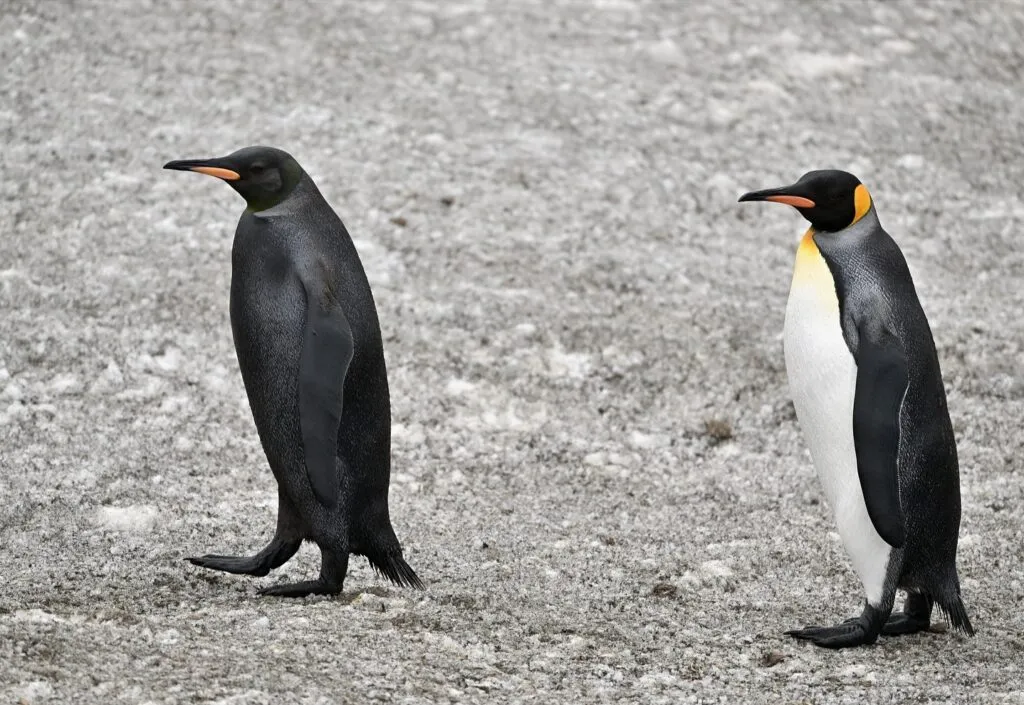
The image feels simple at first. A dense colony of penguins fills the shoreline at St Andrews Bay. Movement is familiar. The pattern is expected.
Then one breaks it.
Almost entirely black, where it should not be.
Captured by Yves Adams, the image does more than reveal rarity. It reshapes how we see something that once felt fixed.
A Familiar Species, Rewritten
The bird belongs to the king penguin species, known for its precise contrast. Black backs. White bellies. Soft yellow accents near the neck.
That balance is not aesthetic. It is functional.
But here, that entire system shifts.
The penguin displays melanism, a genetic condition that causes an overproduction of melanin. Instead of contrast, the body becomes nearly uniform. Even areas that are typically bright white are replaced with deep, dark pigmentation.
And yet, a faint green-yellow iridescence still remains around the neck, a quiet trace of the species’ original identity.
When Rarity Becomes Visible
Melanism is often described as the inverse of albinism. Where albinism removes pigment, melanism intensifies it.
In penguins, this level of mutation is almost unheard of. Estimates suggest a probability close to one in 250 million.
That number does more than explain rarity.
It explains why this moment feels so unlikely to exist at all.
A Visual Shift With Ecological Weight
Penguins are shaped by more than appearance.
Their black-and-white coloration is a survival strategy known as countershading. From above, the dark back blends into the ocean’s depth. From below, the white belly merges with surface light.
This reduces visibility to both predators and prey.
A fully dark body may disrupt that balance.


What makes this penguin visually striking could also make it more visible in the water, subtly altering how it moves through its environment.
And that is where the image deepens.
It is not just rare. It may also be less protected by the very system the species depends on.
Why This Moment Stays
The penguin does not behave differently. It moves with the colony. It belongs completely.
And still, it changes how everything around it is seen.
Because in a world built on repetition,
it only takes one exception to make us notice again.
➡️ Discover more rare and fascinating animal moments in Nature.

